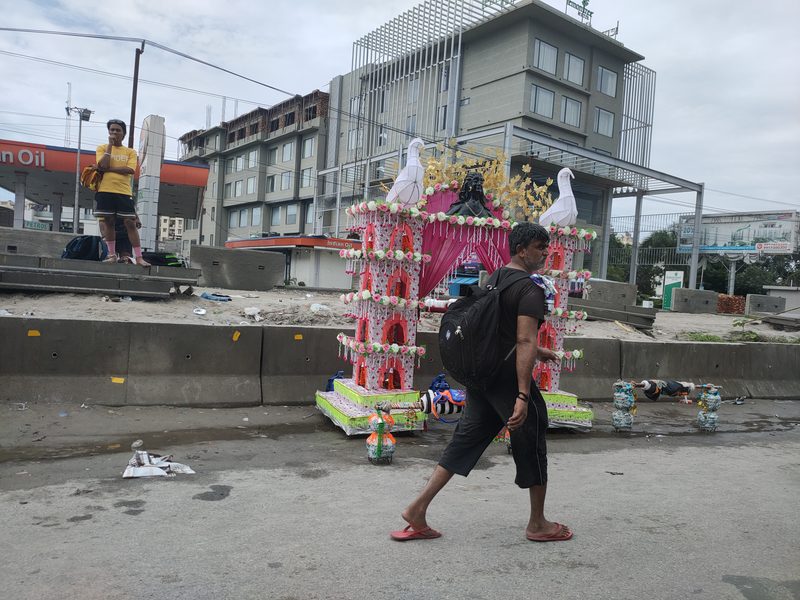
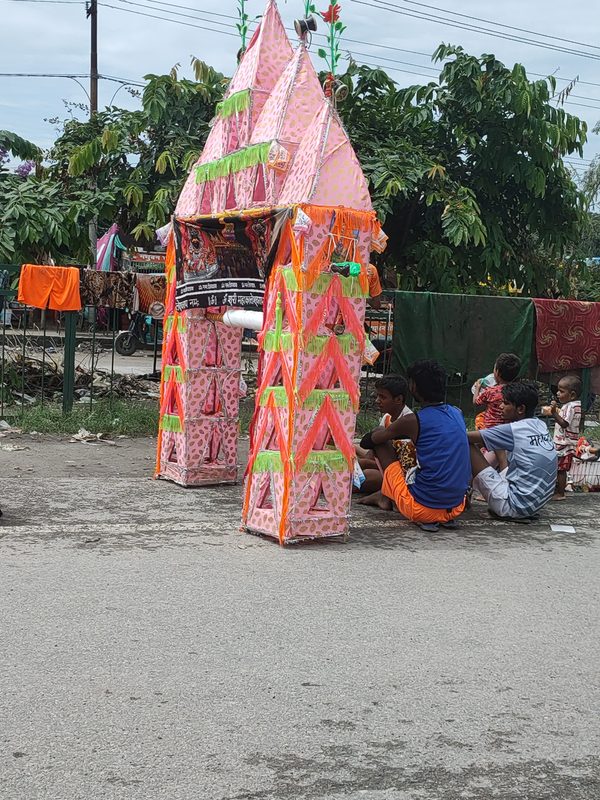
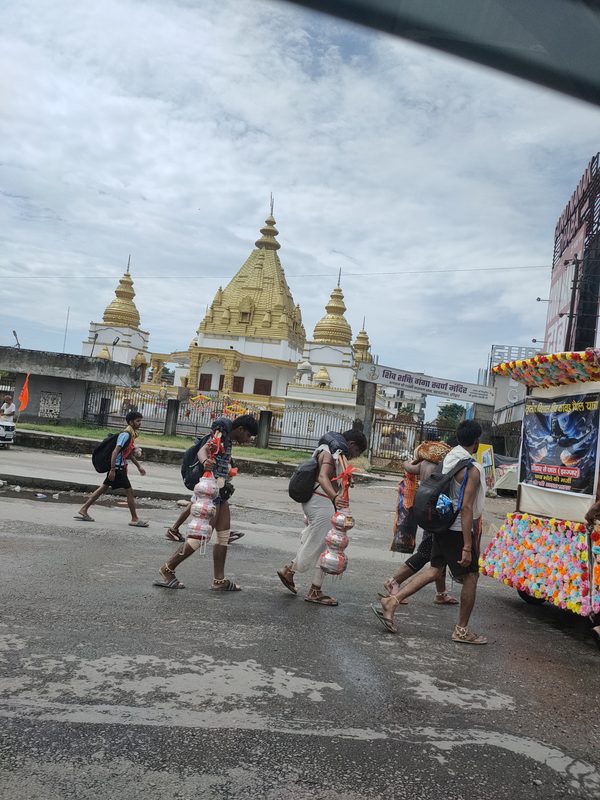
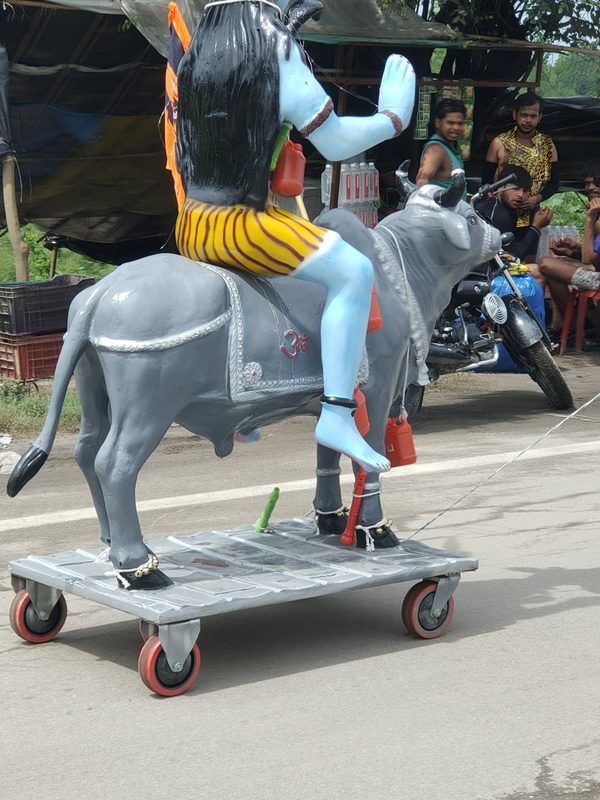
We are on our way to Mathura, which is a long way from Hardwar so we decided to go via Delhi on a supposedly fast road. In fact it was painfully slow because the road was clogged with literally hundreds of thousands of pilgrims, some carrying the beautifully-decorated contraptions on their backs while others struggled under the weight of a bar across their backs with up to five pots of Ganges water at each end. These boys (and a few women) had evidently filled their pots at the beginning of the festival on the 30th July then set off home immediately; that’s the only way they could have travelled barefoot as far as Muzaffurnagar when we passed the first few at the head of the procession. The sight of young lads with spindly little legs struggling under what must have been a massive weight was somewhat awe-inspiring, especially when considered that they could have hundreds of miles to go before they reached their village and presented the water to Lord Shiva at the village temple. It is all rather hard for materialistic Westerners to understand, although Indians might find the spectacle of four silly buggers from Liverpool giving all their money to some Maharishi so he could buy 365 Rolls-Royces (one for every day of the year) so he could drive past a horde of moon-faced half-wits bowing down before him every day rather bizarre. Eventually we got to Delhi and stopped at the Inn Tawang hotel in the Koral Bagh sector of the city. It is very lively, full of hotels and small restaurants.
On the 1st August, Mukesh took us to see the Buddha Vihar Buddhist temple, Mahatma Gandhi’s tomb and museum and the Akshardham temple. The construction of the Buddha Vihar temple was started in 1931 and carried out at the expense of the Birla family. It was formally opened in 1939 by the Japanese Ambassador and contains a large number of pictorial renditions of a story. Sadly we weren’t allowed to take pictures in the temple. The Gandhi tomb was located in a large green area with trees and flowers while the nearby museum was extremely interesting. There was a huge number of photos of his life in Britain (where he worked as a lawyer), South Africa and India and the story of his assassination was particularly poignant. There were frequent references to a woman called Kasturba, although we don’t remember her being described as his wife. They were married when they were both 13 and remained married for 61 years until she died in 1944. Gandhi once said “As we didn’t know much about marriage, for us it meant wearing new clothes, eating sweets and playing with relatives”. As per Indian custom, Kasturba spent the first few years of the marriage at her parents house and Gandhi admits to having lusted after her. They both grew up in a multi-religious sect and were taught elements of Islam and Christianity as well as Hinduism which helps to explain his outlook on life and his philosophy of satyagraha (“peaceful resistance”).
We then went to see the Swaminarayan Akshardham temple but were not allowed to take anything but our clothes into the temple. It was dedicated to Lord Ram and there is a massive gold statue of him in characteristic pose of standing on one leg with the other crossed horizontally across the first leg. The temple is full of beautifully carved pillars, and it relates the story of the mystic Swaminarayan who travelled all over India. He also visited Nepal and the holy mountain of Kailash in Tibet where we went in 2018. He performed lots of good deeds wherever he went, including the abolition of sati in some areas.
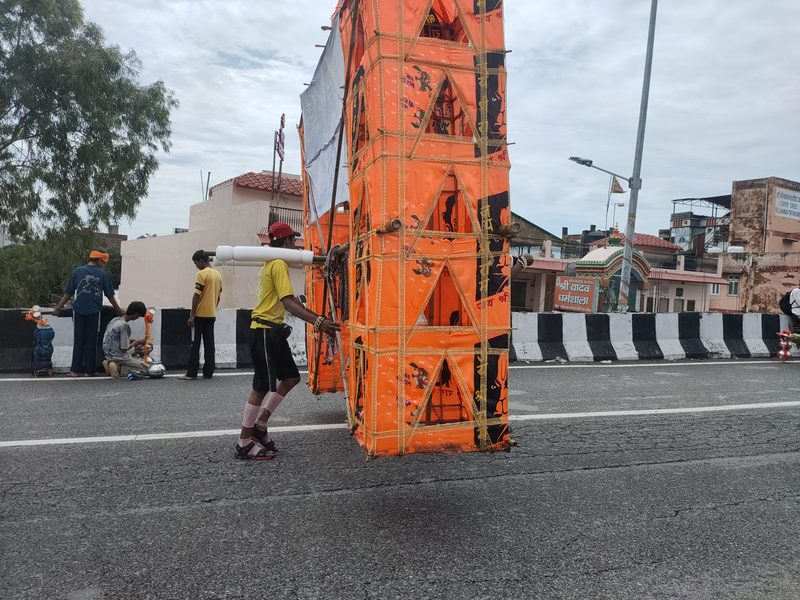
Pilgrim

Golden horse on a trailer

Pilgrims with their pots of holy water from the Ganges