On the 13th we did nothing all day except languish in bed while Ananda’s beautiful wife and lovely mother kept us fed and watered with delicious dal bhat (Nepalese national dish of rice and lentil soup). This was because Jennifer’s foot is not yet entirely healed and because it was raining for much of the day.
The 14th ranged from the bizarre to the sublime. Our dear friend Ananda had booked us on a “tourist bus”, so-called, for the 93-mile ride to Chitwan national park with its elephants, rhinos, hippos, tigers and crocodiles. A taxi took us to the bus park where we arrived on time at midday and where we were somewhat surprised to find that, instead of a large luxury coach, a 10-seater minibus was waiting. We got on board, and the driver travelled 100 metres to a filling station where he spent the next 75 minutes fuelling the vehicle. He then set off again and spent the next 2 hours trying to entice people off the pavement into the bus. At 3.15, after numerous claims that we would leave in the next 5 minutes, we finally lost patience and got off the bus. Fortunately, the main road to the bus station passes the Swayambhunath Buddhist temple, which is one of the main sights in Kathmandu and we decided to give it a visit. Fighting off taxi drivers who wanted to charge us 500 rupees for a short ride, we got onto a bus (which is an experience in itself) and reached the foot of the hill on which the temple stands for 50 rupees. According to my memory from the three times I have been before, the top was reached by a straight row of 500 steps; this time, it was a struggle to find the way to the top and it eventually became apparent that we had approached it from an entirely different direction.
I visited the temple, known generally as the “Monkey Temple” on account of the large number of monkeys who live there for the first time in 1971 when I hired a bicycle and cycled from Shrestha Lodge past fields of barley which the farmers were cutting while singing. It was idyllic. Even by 2014 when I went with Cyrus, it was still a deeply religious place with saffron-robed monks turning prayer wheels to the sounds of beating drums and blowing horns. Today it was basically a tourist honey-pot with hundreds of stalls selling tourist tat and heaving with people including a crowd of Westerners (probably Americans from the look of them) chanting “on mani padme hum” with expressions of extreme piety on their silly faces. Tossers. I expect they don’t even know that it means “praise to the jewel in the lotus” in Tibetan and is associated with the four-armed Shadakshari form of Avalokiteshvara, the bodhisattva of compassion. The mantra is seen as the condensed form of all Buddhist teachings. Swayambhunath is very old with the Emperor Ashoka praying here in the 3rd century BC.

Western entrance to the complex of temples


Prayer wheels


Mani stones inscribed with “Om mani padme hum”


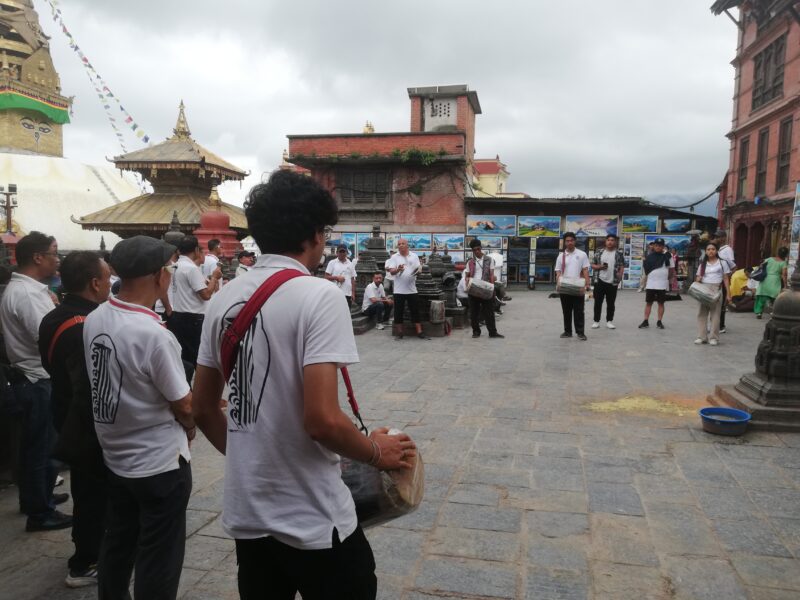

Chaityas courtyard
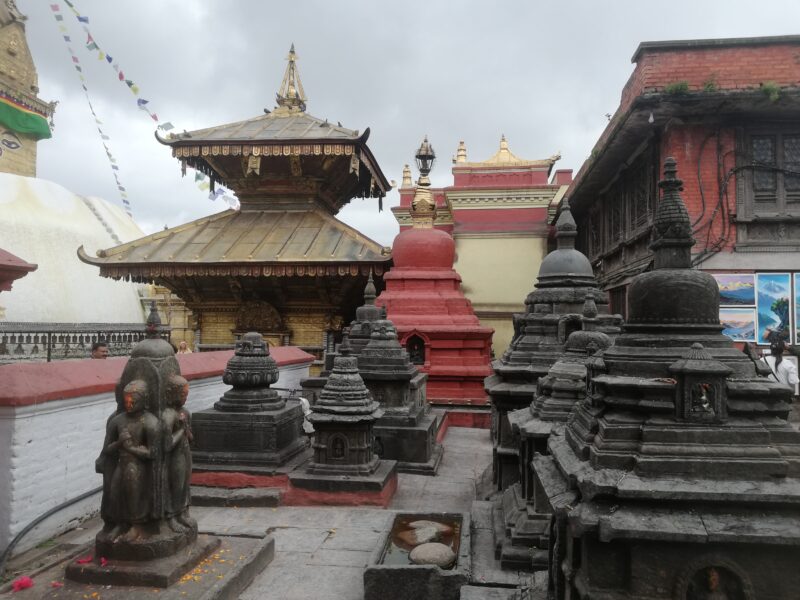
Ajima temple

Main temple


Shikhar-style temple by Pratap Malla


Kathmandu to the east