We had a relaxing day in our hotel bedroom until 3 pm when we had to leave because some new guests had turned up. The sleeper train which Mr Raj had booked for us to Khajuraho was supposed to leave at 6 pm but actually left at 7.40. It should have left from Platform 4 but 5 minutes before departure the screen showed that it was going from Platform 5; this meant a hectic journey through a crowd of millions with their luggage and rising panic as we were unable to find coach A1 in an incredibly long train. We were just about to give up when an official-looking man said “David and Jennifer?” and shunted us into a carriage with seconds to spare. The assumption is that Mr Raj had phoned the station to ask them to look out for us in the belief that we were certain to get lost. Our compartment was for two people (unlike the 4-person compartments on the Trans-Siberian) and was rather shabby but the bunks were comfortable. Unlike the Trans-Sib which glides smoothly along, the train rocked and rolled and rattled and rumbled along, but we had a good night’s sleep and got into the tiny village of Khajuraho at 8.30 in the morning. A boy was waiting for us holding up one of those signs you see at airports, and drove us to the lovely Greenwood hotel set in a beautiful garden. A little black dog ran up to Jennifer wagging its tail; she said “You’re lovely aren’t you. What’s your name?” The manager replied “Um, er, lovely” So we have given the dog a name: “Lovely”.
On Friday morning, we were driven to see a group of temples. The Kandariya Mahadeva Temple was built during the reign of the Chandella king Vidyadhara between 1025 and 1050. The biggest and highest temple at Khajuraho, it is dedicated to Lord Shiva with some glorious carvings of people in erotic poses, although many have had their heads cut off by the Mughal Sikander Lodi in 1495. All the temples have the same basic design: an inner sanctum containing the statue of the god in whose name it was built surrounded by a richly-carved wall. It is located on a high plinth and reached by very steep steps. We then went to see the nearby Jagadambi temple, followed by the Chitragupta temple with an impressive statue of Surya, the Sun God, in the inner sanctum. One of the walls has the unique carving of an eleven-headed figure of Vishnu. The temple was built during 1000-1025.
The Parvati temple is part of the adjacent Vishvanatha temple, although part of it has disappeared. Vishvanatha is the best-preserved example of Chandella temples and has some of the most glorious carving. It was built by the Chandella king Dhanga in 1002. The detached Nandi shrine is an integral part of Vishvanatha and it has a massive image of Nandi, the vehicle of Shiva, facing the temple. The Pratapeshwar temple is built in the Chandella style but is much more recent, built by King Prata Singh who ruled from 1784 to 1854. The Lakshmana temple was built by the Chandella ruler Yeshovarman who ruled between 930 and 950, while the small Varaha temple was built during 900-925 and contains a massive statue of Varaha, a boar which is a reincarnation of Vishnu.
The temples we saw superceded a large number of earlier buildings which were seen by the Chinese traveller Xuanzang in 641, who states that there were several dozen inactive Buddhist temples and dozen Hindu temples with 1,000 devotees. The Moroccan traveller Ibn Batuta visited the temples during has stay in India from 1335 to 1342.

Kandariya Mahadeva


Jagadambi temple


Chitragupta temple


Surya the Sun God


Parvati temple

Nandi shrine of the Visvanatha temple
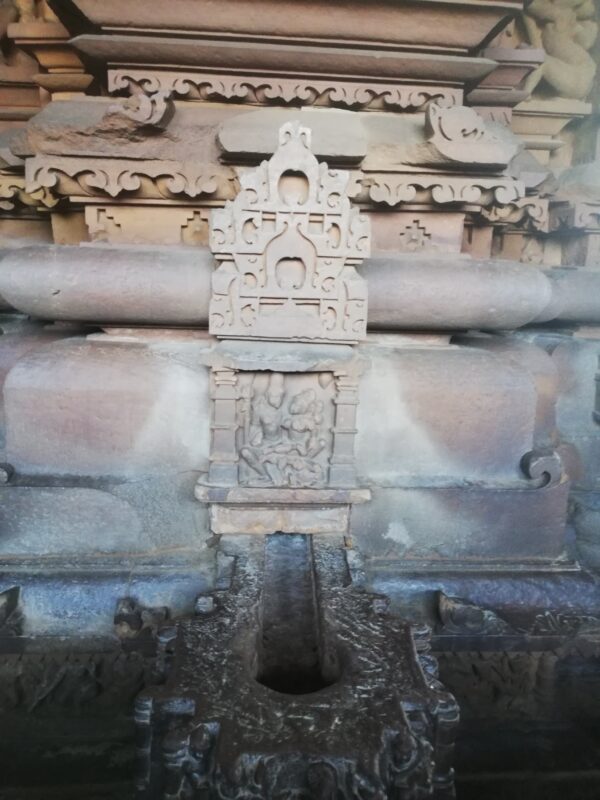


Lakshmana temple

Varaha temple

The boar in Varaha temple
9 thoughts on “Days 31-32 (26-27 February) Delhi to Khajuraho”